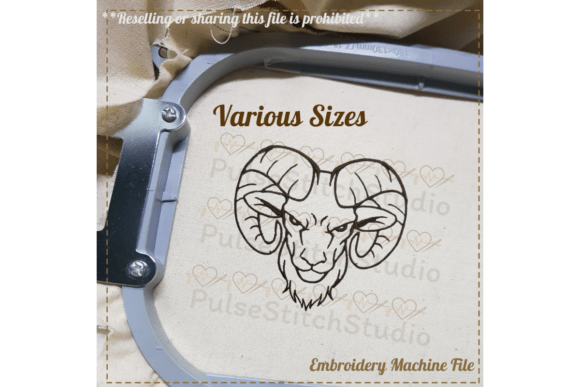
Ram Outline Embroidery Design
A Practical Review for Small Business Merch & Branded Patches
As an embroidery designer who’s developed hundreds of commercial designs for cafés, boutiques, florists, pet brands, and handmade studios, I approach every new machine embroidery design with two questions: “Does it translate into real-world brand value?” and “Will it hold up across diverse applications—from staff aprons to customer tote bags?” That’s why I took the Ram Outline Embroidery Design through a full business-use evaluation. It’s not just about aesthetics—it’s about durability, recognition, scalability, and how well it supports your brand identity without compromising production efficiency.
First Impression: Rustic Charm Meets Clean Professionalism
The title alone—Ram Outline Embroidery Design—immediately signals clarity and purpose. There’s no clutter, no overwrought detail—just a confident, single-weight outline. Visually, it reads as rustic yet refined: grounded enough for a farm-to-table café or heritage wool brand, but sharp and modern enough for a creative studio or indie pet label. It avoids cartoonishness while staying approachable—critical when your logo needs to resonate with both longtime locals and new online buyers. As a Farm Animals-category design, it leans into authenticity rather than novelty, which builds trust faster than overly stylized alternatives.
Where It Shines in Real Small Business Applications
This design excels where many animal motifs fail: versatility without dilution. On a 2.5-inch embroidered patch sewn onto denim aprons for a boutique bakery? Crisp and legible. As a chest accent on organic cotton tees for a sustainable florist? Balanced and unobtrusive. As a cap embroidery piece for a small ranch-wear line? Bold enough to read at arm’s length, subtle enough not to overwhelm.
- Staff uniforms: Works beautifully on left-chest placements—low stitch density means breathability and wash resilience.
- Tote bag design: Scales cleanly to 4–5 inches on canvas or heavy cotton duck; maintains integrity even with slight fabric stretch.
- Apron embroidery: Holds definition on textured linen-cotton blends when paired with medium-weight cutaway stabilizer.
- Cap embroidery: Fits comfortably within standard front-panel hoop sizes (most common 4×4 or 5×7) without distortion on curved crowns.
- Product packaging accents: Ideal for stitched tags on handmade soap wraps, seed packet labels, or gift box closures—adds tactile premium feel.
- Etsy branding: Translates seamlessly into printable mockups for digital storefronts, reinforcing handmade product credibility.
Careful Use Cases: Know the Boundaries
Like any strong outline-based design, the Ram Outline Embroidery Design has smart limits. It’s not ideal for sub-1.5-inch patches—details begin to blur, especially on dense fabrics like twill or fleece. Avoid placing it directly over seams or high-flex zones (elbows, shoulder yokes) unless you reinforce stitching with a lightweight tear-away stabilizer underneath. On dark uniforms, test thread colors carefully: a matte charcoal or deep forest green often reads more professionally than stark black. And while it handles frequent washing well, skip it on ultra-soft tri-blends unless you reduce top tension slightly—fine outlines can sink into plush textures.
Brand Identity Impact: More Than Just a Motif
This isn’t decorative fluff—it’s functional brand architecture. A ram silhouette carries quiet strength, resilience, and grounded energy—ideal for businesses that emphasize craftsmanship, local roots, or natural materials. When repeated across aprons, tote bags, and staff caps, it creates visual consistency that customers begin to recognize instantly. That recognition builds trust: shoppers associate the clean, confident outline with reliability and care. For Etsy sellers or craft-based brands, it signals authenticity—not mass-produced, but intentionally chosen and thoughtfully applied. Even in digital spaces, the simplicity ensures legibility in thumbnails, social bios, and email headers.
Essential Embroidery Designer Notes Before Production
Before committing to bulk runs or client delivery, here’s what I always verify with any digital embroidery file:
- Test in monochrome first: Run a black-and-white stitch-out to assess spacing, corner sharpness, and overall balance—no color distractions.
- Validate small-scale performance: Resize to your smallest intended use (e.g., 1.75" for cap fronts) and check for broken curves or thinning lines.
- Review thread color contrast: Especially on textured or dark fabrics—what looks great on screen may vanish mid-stitch.
- Inspect spacing between elements: Ensure no floating threads or unintended gaps that could snag or fray.
- Confirm hoop size compatibility: Match your machine’s most-used hoop to avoid re-hooping mid-job—efficiency matters in commercial embroidery.
- Test on real fabric: Always stitch a sample on your actual garment or patch material—not just stabilizer.
- Use appropriate stabilizer: Medium-weight cutaway for structured items (caps, tote bags); tear-away for lighter apparel like t-shirts.
- Create a printable mockup: Show clients exactly how the Ram Outline Embroidery Design will appear on their chosen item—builds confidence and reduces revisions.
- Compare beside existing design assets: Does it harmonize with your current logo, typography, and color palette—or does it compete?
- Verify commercial licensing: Since this is intended for small business merch, ensure the embroidery file includes rights for resale, branded goods, and client projects.
Remember: the description notes it’s designed for kitchen signs, towels, home decor, clothing, tote bags, t-shirts, and gifts—and comes with multiple embroidery file formats. That flexibility is a major asset—but only if you confirm those formats match your machine (PES, DST, JEF, etc.) and that the design scales cleanly across your intended applications. If exact hoop size, stitch count, or license terms aren’t listed, reach out to the seller before ordering for commercial embroidery.
In short, the Ram Outline Embroidery Design is a quietly powerful tool for small business owners building cohesive, memorable, and production-ready custom apparel and branded patch systems. It doesn’t shout—but when placed intentionally, it speaks volumes about quality, intention, and care.